
What Charles County Deeds Record
Deeds in Charles County are filed with the Circuit Court Clerk's Department of Land Records. Each instrument names the grantor and grantee. It states the interest conveyed, and it usually carries a legal description, an acknowledgment, the consideration, and references to earlier records. Mortgages, releases, liens, powers of attorney, easements, and certain leases live in the same land-record system. Not all of them transfer ownership, though. Only the deed itself moves title to a parcel.
| Deed Type | What It Does | Common Use |
|---|---|---|
| Warranty deed | Conveys title with stated warranties | Ordinary arm's-length transfer |
| Quitclaim deed | Conveys whatever interest the grantor holds | Family or title-cleanup transfer |
| Trustee deed | Transfers in a trustee's stated capacity | Trust or foreclosure matter |
| Personal representative deed | Transfers property from an estate | Probate administration |
| Corrective deed | Corrects a recorded error | Name or description correction |
Read the deed type from the instrument itself. Never guess it from the price paid. A mortgage or judgment can burden a parcel while the owner of record stays the same. A release can lift that burden later, so follow the cross references.
Where Charles County Deeds Live
The Charles County Circuit Court Clerk keeps the land records at 200 Charles Street, La Plata, Maryland 20646. Reach the office at 301-932-3201 or 301-870-2659. The Clerk's office records deeds, mortgages, plats, and conveyances, and it offers research access at the courthouse.
Maryland State Archives
Charles land-record series
Paper, microfilm, and electronic guides
MDLandRec images make online work convenient, but the courthouse terminal and the Archives series remain essential fallbacks. You must run the deed search yourself; deputy clerks will not trace title or pick records for you.
Charles County MDLandRec Controls
Today's MDLandRec supports direct book-and-page retrieval plus a combined party search. The fall 2025 redesign added a free account migration process, access codes sent by email for two-factor authentication, and one-device-at-a-time access.
| Search control | Purpose | Useful distinction |
|---|---|---|
| Clerk, Book, Page | Opens a cited instrument | Best route from an SDAT deed reference |
| Last Name and Corporation Name | Searches a party | Use entity spelling and name variants |
| Legal Capacity | Filters a role | Can distinguish trustee or representative |
| Party Type | Chooses grantor or grantee | Direction matters in a deed chain |
| Instrument Type | Narrows the document class | Separate deeds, releases, and related filings |
| Remarks and Cross Reference | Finds linked records | May expose corrections or releases |
The portal's official guide describes the search fields. Full Charles results require an authorized login. An SDAT deed citation gives a verified local starting point.
The Charles County Login Gate
The MDLandRec login page displays the account, sign-in, and access-code gate. That gate stands between a citation and many online deed images.
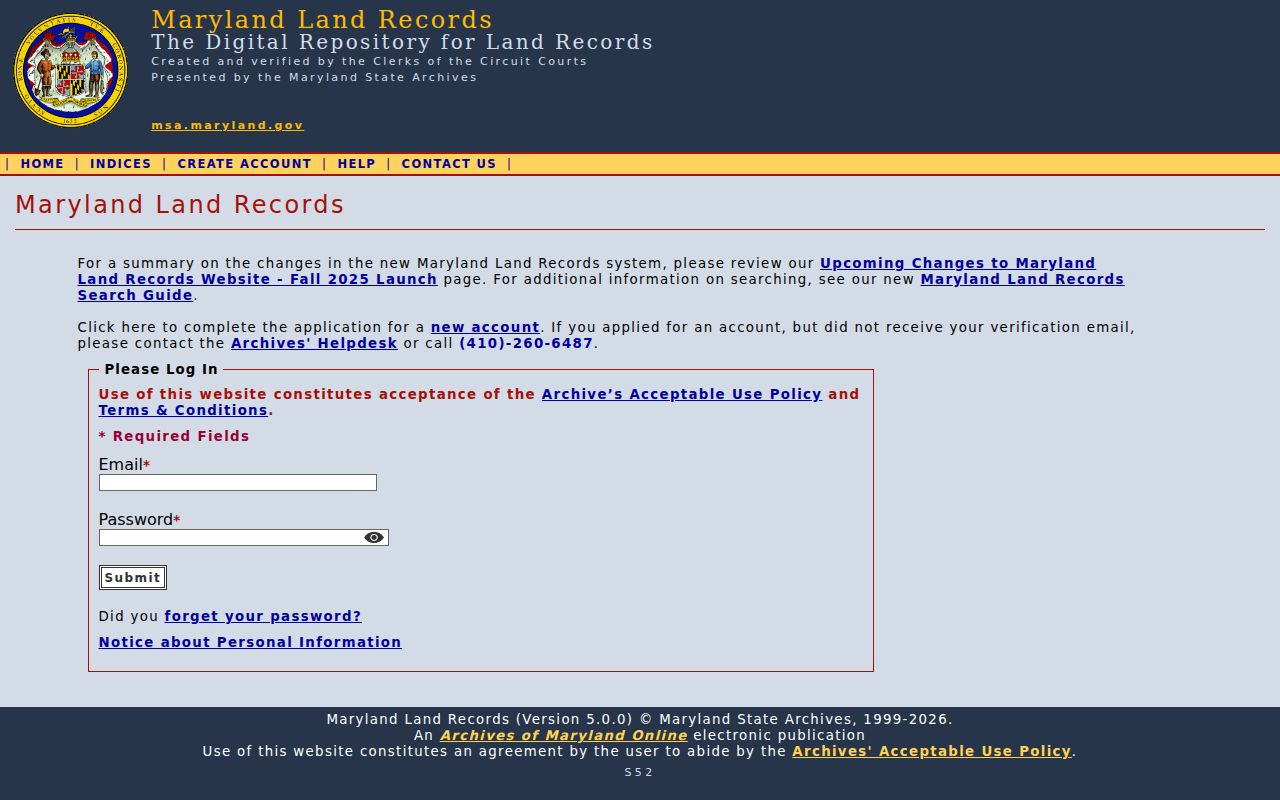
The gate controls access. It does not seal the deed. If login fails or an index comes up empty, carry the book and page to a courthouse terminal, or ask the Clerk for that exact copy.
Trace the Charles Grantor-Grantee Chain
A chain of title follows one parcel through its successive transfers. Start with the current SDAT deed reference. Pull the full deed. Then use the prior owner and the earlier citation to keep moving back in time. Names may repeat. Tract boundaries may shift. When they do, the legal description and any plat reference become your best guides.
- Open the latest cited deed by clerk, book, and page.
- Record the grantee, grantor, legal description, capacity, and prior deed reference.
- Search the grantor as a prior grantee and confirm the land description.
- Repeat through related deeds, corrections, releases, and plats.
- Switch to the matching Archives index and volume when the online path ends.
- Grantor
- The party conveying an interest.
- Grantee
- The party receiving the interest.
- Chain of title
- The linked sequence of recorded transfers for the land.
- Book and page
- The liber and folio citation used to locate a recorded document.
Charles Land Records Reach 1658
The Maryland State Archives holds original Charles County land records from 1658 through 1899, plus later dedicated grantor and grantee series. Series CE263 covers the original land records. CE264 holds grantee records from 1899 to 1992. CE265 holds grantor records for the same span, and CE84 supplies an index spanning 1832 to 1948.
Microfilm and container guides extend that route. C670 and CE82 cover the earliest land records. CM394, with related runs CM395, CM398, CM399, and CM400, supply records and indexes, while T4119 covers land-record microfilm from 1851 to 2005. These dates mark archival series, not a promise that every image sits behind one modern search screen.
Oldest horizon. Charles series reach 1658, while clearly described grantor and grantee series begin in 1899.
The 1892 Fire Preserved Clues
The Port Tobacco courthouse burned on August 3, 1892. The county seat moved to La Plata in 1895. Yet the fire never erased the whole land record. Bound records and extracts had already gone to Annapolis, so valuable older material survived, according to the Archives account. Liber A, covering 1658 to 1662, had been held by the Maryland Historical Society since 1886.
That custody history should shape your search method. A missing local screen points to a series-guide search in Annapolis, not to a claim that the deed burned. Old tract names, proprietor names, and later deed references often work better as keys than a modern street address.
Read Charles Deed References Fully
A book and page is a locator, not a summary of rights. Read the whole deed. Every part matters. The grant and the consideration matter. So do the legal description, the exceptions, easements, covenants, acknowledgments, capacities, and prior references. Pull the cross-referenced releases and correction instruments before you draw any conclusion.
Plats can be retrieved through the Maryland plat system. They can also be ordered from the Archives using the county, a citation, book and page, plat number, or a description. Charles series C2266 covers land-record plats from 1856 to 1958. CM1408 microfilm covers 1856 to 1932. A plat clarifies lot layout. A current boundary dispute still calls for a survey and the controlling instruments.
Get a Charles County Deed Copy
Use a free MDLandRec image for everyday research. Try a courthouse terminal when online access falls short. The Clerk's counter is best for the official record. When you know the exact book and page, the Clerk accepts copy requests by mail. Maryland Courts lists plain land-record copies at 50 cents per page. Certification adds a fee, so check the current court schedule before ordering.
For old volumes, pin down the exact Archives series, volume, and citation first. Local research staff can explain access rules. They will not run a title search. The Charles Clerk research page documents the microfilm and in-office limits.
Recorded, not guaranteed. Charles County deed records show filed instruments, but they do not certify title, survey lines, lien priority, or unrecorded interests.
Check Related Charles Instruments
A deed chain holds up best when you check the records around it. Pull the mortgages and releases. Pull the easements, the correction instruments, and any plat the deed cites. Powers of attorney matter too. The redesigned MDLandrec has remarks and cross-reference fields. These can surface a related book and page a plain party-name search in Charles County property records will skip.
Estate property needs extra care. Legal capacity matters here. It can tell a personal representative, trustee, survivor, or agent apart from a plain-name match. When it matters, follow the probate or Orphans' Court file. Then come back to the recorded deed that actually conveyed the land. A probate record explains who had authority. It does not replace the conveyance itself.
Charles Deed Research Audit Trail
Good deed research leaves a trail. Save the exact portal URL, the search date, the clerk, book, and page. Note the party spelling, capacity, instrument type, legal description, and every prior reference. Write down whether you viewed the image itself or only an index entry. A blocked login, a late index, or a missing image is part of the record trail. It is not a dead end.
Next, compare the recorded date against SDAT's transfer row and the tax account. SDAT treats the recording date as the transfer date, which can lag settlement. If the dates or names clash, trust the full instrument and its acknowledgment. Do not rely on the summaries. Never force them to match.